
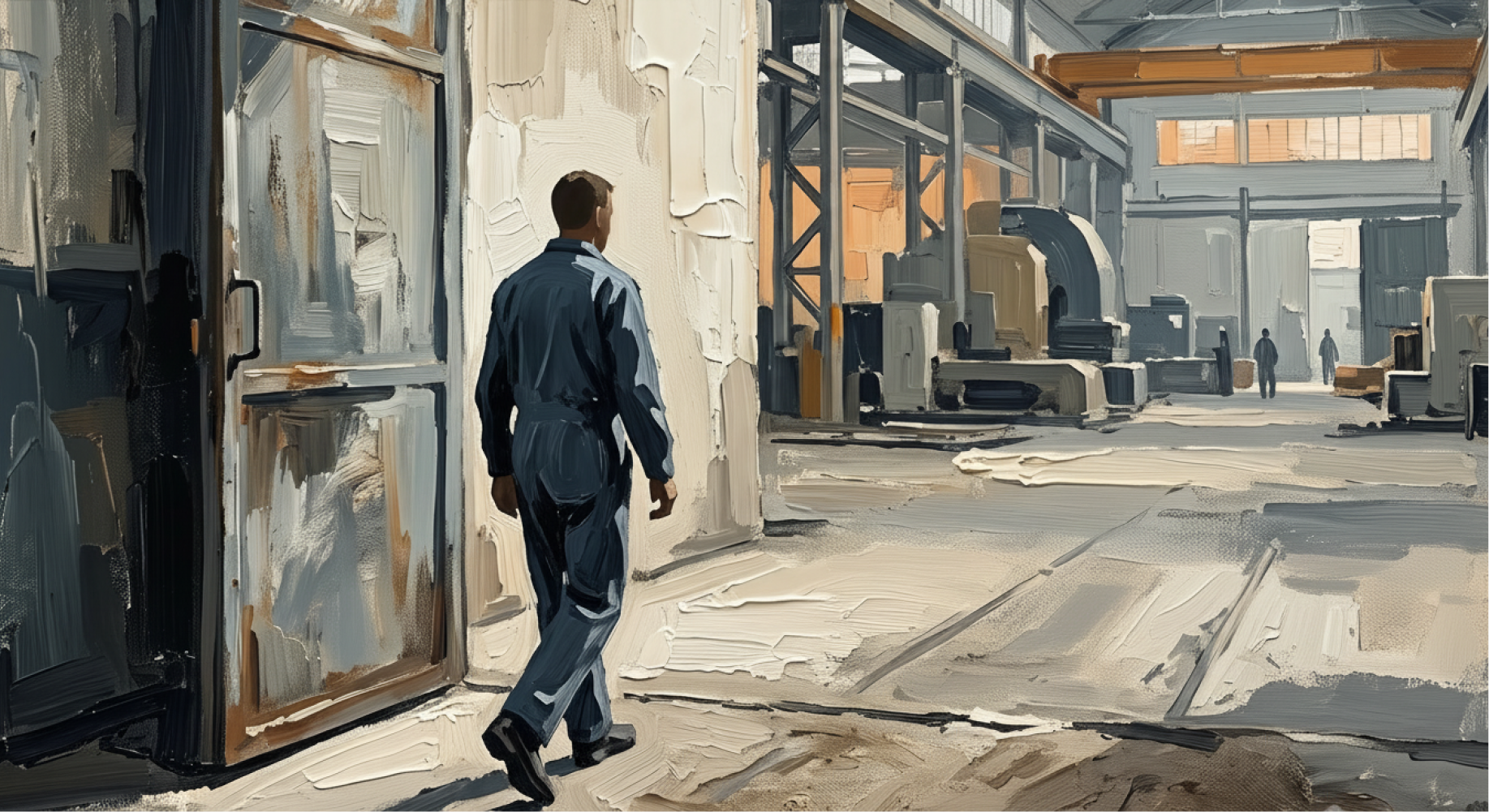

The factory floor is the most obvious software opportunity you'll never be allowed near.
Walk one for fifteen minutes and you see it: one planner that carries the whole system in their head. Every schedule, every constraint, every exception is built from fifteen years of pattern recognition that lives nowhere else. The problem is visible. The way in is not.
A Tier-1 manufacturer's COO does not open their production line to someone they met at a demo day. Not because they don't want the technology, but because trust in industrial operations is slow, organizational, and earned over years. The procurement cycle from first meeting to signed contract spans quarters. The pilot requires safety sign-off, IT integration, and management buy-in at 3 levels. Before any of that, the factory has to agree to let you in at all.
There is a name for what solo founders pay to earn that permission. The access tax. And nobody puts it in the startup playbook before you start paying it.
Factory access runs on organizational trust
A COO evaluating an unknown software vendor is pricing one risk above all others: the risk that you will cost them a year. They have watched transformation projects fail with their name attached. They know what it takes to move a procurement decision through a large manufacturing organization. Organizational trust attaches to a track record, references in the industry, relationships tested over time, a name that someone they respect already vouched for.
The consequence is specific: a COO will not take a call from a company they've never heard of. The first real conversation arrives through someone who vouches for you: a design partner, an operator who already trusts you, an introduction from someone the buyer respects. Without that vouching relationship, the access layer stays closed regardless of what the product can do.
For a solo founder entering industrial operations, those relationships don't exist on day one. Building them takes years. Most founders discover this after they've already spent those years trying.
Earning entry takes 12 to 18 months
The path to a first qualified, paying factory deployment has layers, and they compound.
Cold outreach into industrial accounts produces no-shows. The first meeting worth having arrives through a relationship, and the relationship has to exist before the meeting. When procurement does start, it spans quarters: safety sign-off, IT integration review, management buy-in at multiple levels, contracts that require references you don't yet have. And then the pilot, which is where the real bottleneck lives. McKinsey's research on digital manufacturing found fewer than 1 in 3 companies had moved critical use cases to company-wide rollout. Not because technology failed. Because the organizational permission to deploy at scale, the layer above the product, above the pilot, above the signed contract, never arrived.
Running a pilot and scaling a pilot are two different problems. Most industrial software stalls between them.
The cumulative result: months to earn the introduction, months more to build the relationship before procurement starts, procurement spanning quarters, and then a pilot with worse-than-1-in-3 odds of scaling. For a solo founder starting cold, 12 to 18 months to a first qualified, paying factory deployment is the optimistic case. Not the disaster scenario.
Most founders discover it in arrears. A year of meetings that felt promising, pilots that never converted to paid deployments, a purgatory of "interesting" demos at companies that never opened their production floor. By the time the shape of the tax becomes clear, they've already paid most of it.
The access layer can be inherited
The access tax is structural. The response to it is structural too.
A founder who enters with the industrial network already in place doesn't spend the first year earning access. That year goes into building the product. The first 50 client conversations are handed over on day one, not earned cold. The anchor client is in place before or in the first weeks of the build. The factory walk-through happens in week one of the product.
The outcomes are documented. The OSS portfolio target for year 1 is €500K revenue. That number requires paying clients in the room within weeks of founding, which is only possible when the access layer already exists at the start.
OSS has built 22+ companies since 2019, of which 11 have raised a Series A and 4 a Series B. The portfolio runs in ~3,800 industrial sites globally, with ~200,000 monthly users. Product-market fit in 9 to 15 months, repeatably. The access claim is grounded in a track record: 22+ companies that have already cleared the layer solo founders spend 18 months trying to reach.
The access tax changes the frame for how to evaluate the question of going solo versus joining a studio in industrial operations. The question has never been about individual capability. Two founders with equivalent products, starting from different access positions, face completely different cost structures before they write a line of code.
A solo founder starting cold answers the access question with 12 to 18 months and a list of relationships that don't exist yet. A founder who inherits an established industrial network answers it on day one. The starting position is what determines everything before the product is built.
