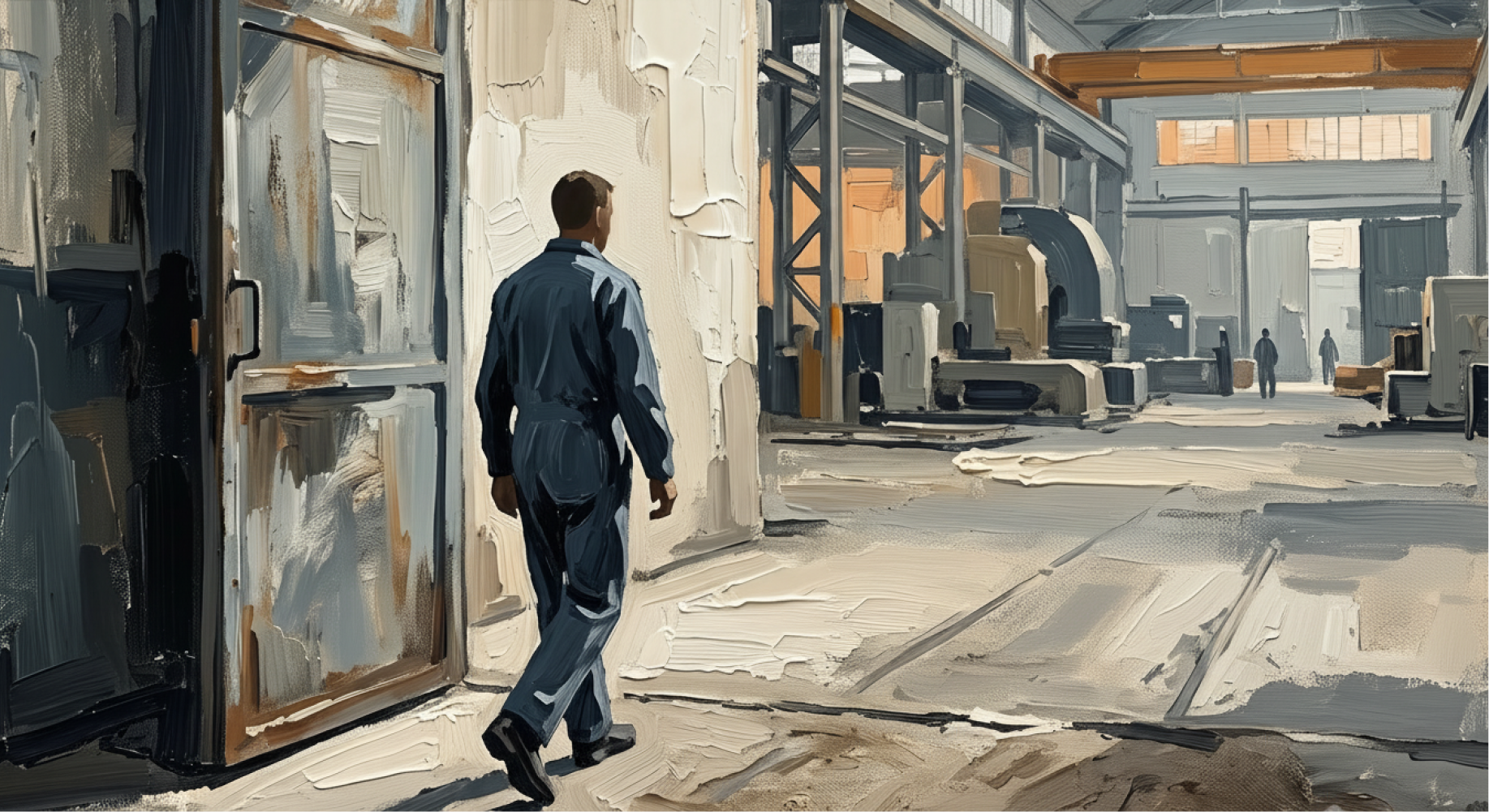
There is a person on your floor whose head holds a rule set no system records. A planning supervisor who replans the paint schedule ten times a day. A process engineer who knows which line drifts in humid weather. When that person is out for a week, the line slows. Not because anyone stopped caring, but because no one else has the model.
You know who they are. Most executives do. What most of us never say out loud is the uncomfortable part: that knowledge lives in a person because no system was ever built to hold it. Software was designed to record transactions, not to capture judgment.
That is not a change-management problem. It is a design assumption, and it is about to become the defining operational risk of the next decade.
The knowledge was never the system's. It was always a loan.
ERPs capture what happened. None of them capture why the schedule changed, what rule the planner applied, or what the experienced operator noticed before the machine threw an alarm. The system runs on borrowed judgment it never wrote down.
For most of industrial history that loan was safe, because the lender never left. That assumption is now expiring. Manufacturing will need to fill roughly 3.8 million jobs by 2033, around 2.8 million of them from retirements (Deloitte + The Manufacturing Institute, 2024). The same Institute found as far back as 2019 that 97% of firms were concerned about brain drain and nearly half were "very concerned." The worry is old. What's new is the maturity date.
When the lender retires, the loan is called. The rule set walks out the door, and the system is suddenly running on a model no one can read.
Every AI pilot that routes around the expert fails in practice, even when it succeeds on paper.
Here is the pattern, and it is almost always the same. The vendor rolls out the planning tool. The expert overrides it. The floor follows the expert, not the system, because she has never been wrong and the system has. The PMO marks the pilot a success. Nobody uses it.
That is why so much industrial AI stalls. Nearly two-thirds of companies have not begun scaling AI across the enterprise; in manufacturing, only 2% say it is fully embedded across operations (McKinsey, State of AI, 2025). The reflex is to blame budget or technology. It is neither. The pilot fails because the system being piloted has no model of what the expert knows. You automated the org chart. You should have automated the judgment.
It is not a technology problem. It is a sequencing problem.
You cannot automate what you have not made explicit, and you cannot make it explicit from a conference room.
This is the whole thesis, and it inverts how most transformation programs run. They buy the system, then try to retrofit the expert's knowledge into it. Backwards. The knowledge is the specification. The system is downstream.
Three things have to happen, in order, before any deployment can hold:
- Map what the expert knows, explicitly, with them, on the floor. Not the theoretical process. The real rule set: what they check, what they override, and why.
- Build the data model around the actual rule set, not the one in the SOP binder.
- Give the expert ownership of the system they helped design, so adoption isn't imposed. It's authored.
Skip the first step and you are automating the wrong thing. The AI will be fast. It will be wrong.
What this looks like when you do it right.
One illustration. At a Decathlon bicycle-components supplier in Romania this April, the first thing the floor told us was that the planning supervisor was the system: eight years of rules, none of them written down. At Teknor Apex's Rhode Island site, OSS spent time on the floor mapping what the planners, allocators, and process engineers actually knew before writing a line of code. Changeover time fell 33 to 50% by product category; efficiency rose around 10% on priority lines.
The number that matters most isn't on that list. It's that one solution became a reusable blueprint. The next factory doesn't start from scratch; it starts from a model. The expert's knowledge compounds across the network instead of retiring with one person.
That is the real shift. The Excel Hero doesn't disappear. They become the architect of the system that outlives their own heroics.
The bet for the next decade.
The competitive edge in industrials is moving. For twenty years it was whoever ran the leanest process. For the next ten it will be whoever digitizes tacit expertise first: before it retires, before a competitor builds the model, before the loan gets called with no one left to lend.
Three questions worth taking to your next operating review:
- Who in your organization holds knowledge that no system records?
- What happens to the line when that person is out for a week?
- Do your AI pilots have a model of what that person knows, or are they routing around it?
If the third answer is no, you're not behind on AI. You're behind on the one thing AI needs to work.