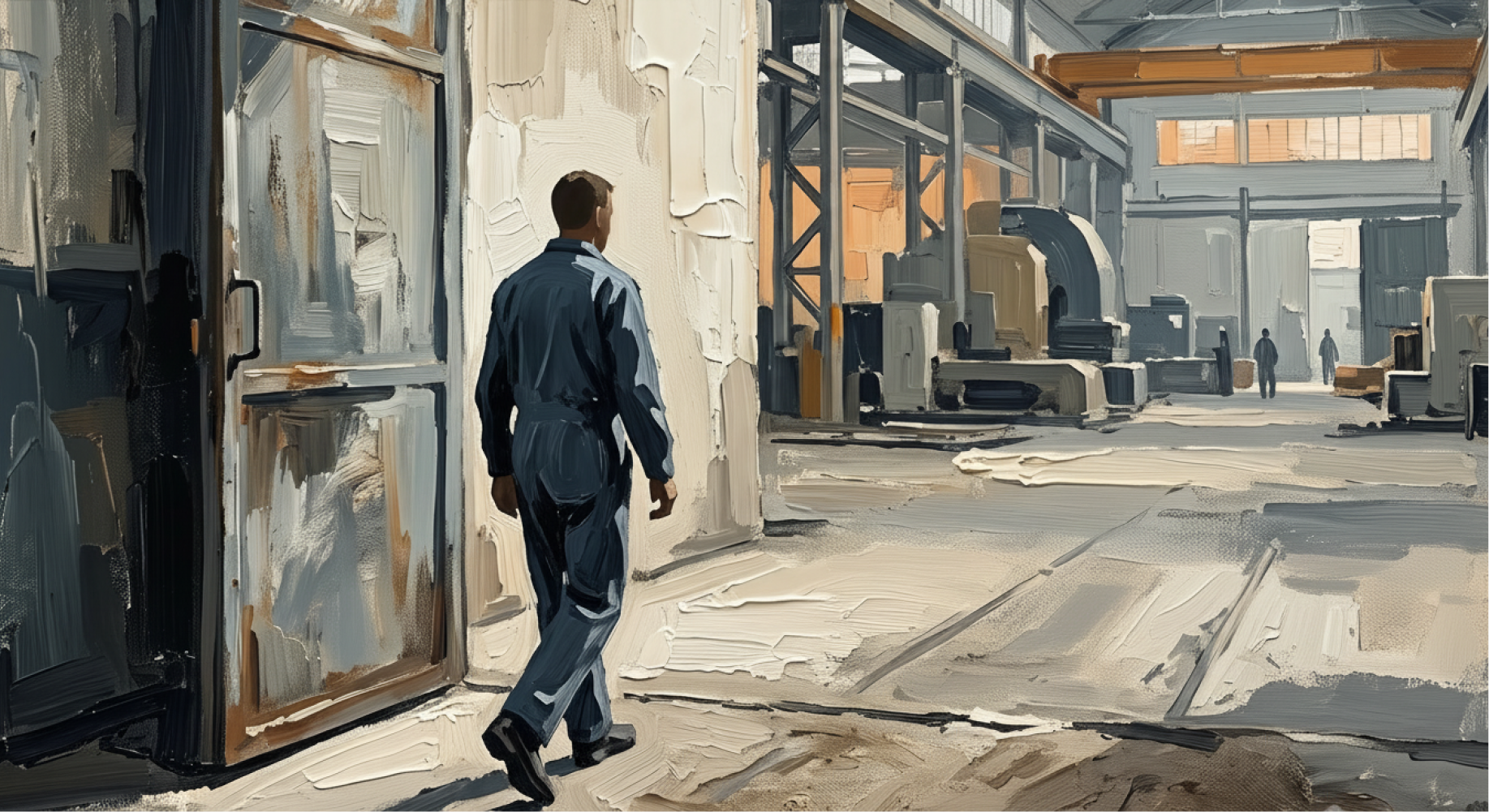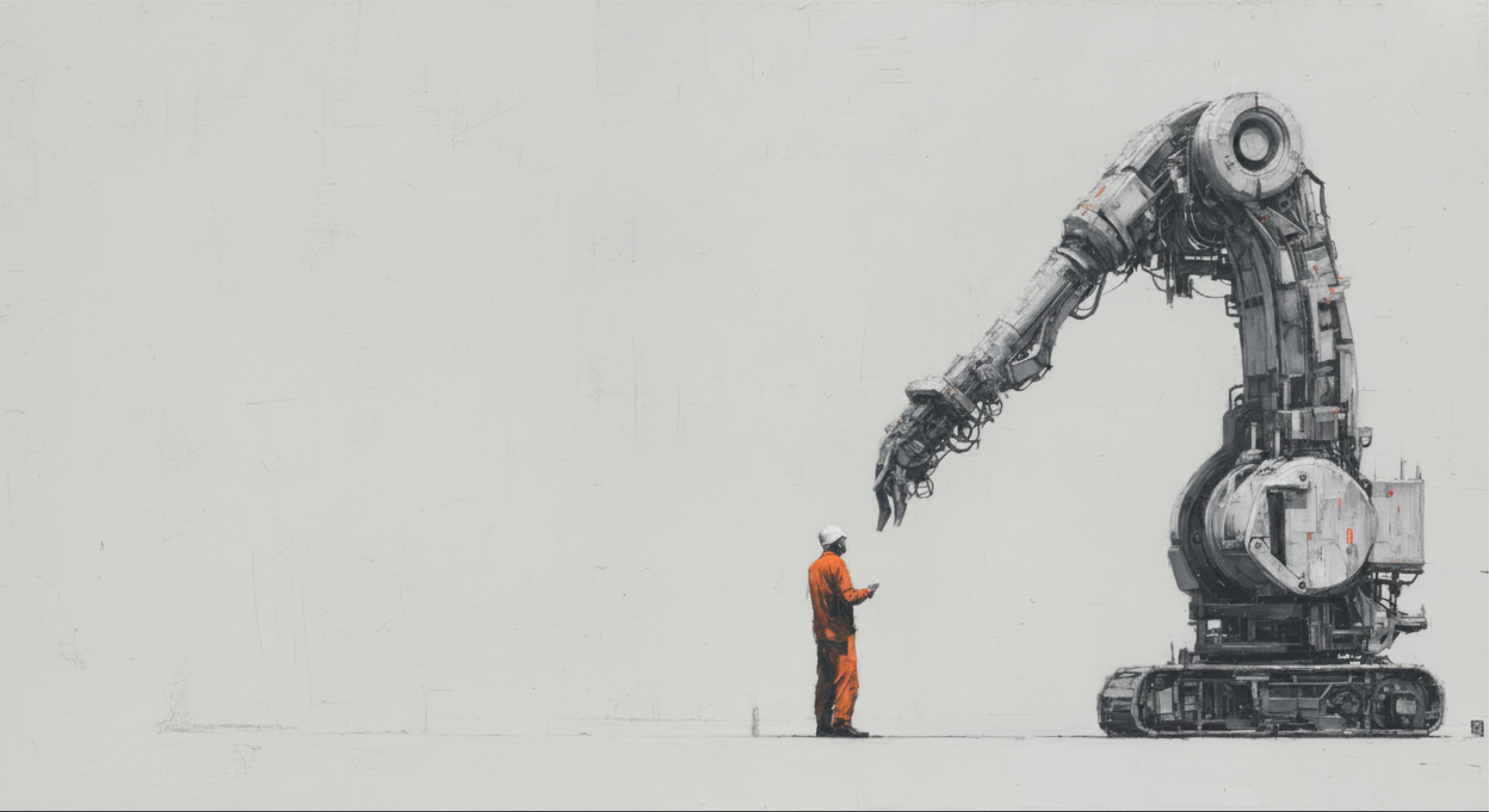

The capex is approved. The vendor demo ran clean: the robot arm picked, placed, indexed, never hesitated; the AI model flagged the defect before the operator would have. The board wants a smart-factory line in the annual report. Whatever the project (a robot cell, an automation rollout, an AI system), it's the obvious next move, and everyone in the room agrees.
Here is what the room hasn't agreed on, because no one has asked: why does Tuesday's batch drift? Who overrides the schedule on Friday afternoon, and on whose say-so? Why does line 3 run six points under line 4 on the identical part? The honest answer is that this knowledge isn't in the ERP. It lives in the heads of the people who run the line; most factories have never written it down.
Automate or digitize on top of that and you don't remove the problem. You industrialize it. A misunderstood line doesn't become an understood line because a robot now feeds it or an algorithm now reads it. It becomes a faster version of the same mess, at higher capex, with the dysfunction now running at machine speed.
So understanding the line is not the thing you do before the automation project. It is the automation project. The return on a robot (or an automation line, or an AI system) is decided before it's bought, by how well the line was diagnosed first.
That's a discipline, not a slogan. Here is why it holds, and where it leads.
Automation is an amplifier, not a fix
McKinsey studied why automation programs derail and reached a blunt conclusion: "Treating automation as a technology-led effort can doom a program to failure. Process problems can rarely, if ever, be tackled simply by introducing a new technical solution." Put plainly: if the process is broken before you automate, automation makes it broken faster.
The scoreboard backs this up. In 2018, more than 70% of manufacturers running advanced-technology pilots were stuck in what McKinsey and the World Economic Forum called "pilot purgatory": proofs of concept that worked in one corner and never scaled. By 2022, only 11% had successfully scaled those technologies across their production networks. Years on, the gap is the same shape. Most of that money didn't fail because the technology didn't work. It failed because the technology was pointed at a process nobody had understood first.
A robot is faithful. It does exactly what the line tells it to do, all day, without complaint. That faithfulness is the whole problem when the line is telling it the wrong thing.
The deciding data isn't in the system you're automating
Here is the part that makes this hard. The information that determines whether automation pays off is not in the system you're about to automate.
After we shipped more than 80 complex AI systems to factories over two years, the pattern was hard to miss: our working estimate is that at least 40% of the operationally relevant data in any factory lives in people's heads and nowhere else. Not in the ERP, not in the MES, not in the dashboards. In the operator who knows the second hopper jams when humidity climbs, in the planner who quietly resequences every Friday, in the supervisor who can hear a bearing going.
You can automate a welding station. What you can't easily automate is the half-dozen people who coordinate, schedule, report on, and argue about that welding station. Buy a robot for the station and you've touched the easy 60%. The 40% that decides whether the robot helps or just runs faster is still trapped in conversation, instinct, and habit.
The work, then, is to make that knowledge legible; the only way to do it is with the operators who hold it, not around them. This is unglamorous, and it is the whole game. Give a team the means to turn what it knows about its own procurement, inventory, and production into something the whole factory can see, and the gains come quickly: one of our companies, Bonx, delivers +30% operational productivity once that knowledge is captured. Not because a machine replaced anyone, but because what people already knew finally became something the factory could act on. You can't automate your way to that. You have to understand your way to it first, alongside the people who already do.
The factories that win automate second
The best operators have known this for decades. Toyota's jidoka ("automation with a human touch") is built on understanding the process through manual work first, wiring in the logic to stop on a defect, and only then scaling. Understand, then automate. In that order, on purpose.
The contrast is just as instructive when it runs the other way. Tesla over-automated the Model 3 line and paid for it, and Elon Musk said so himself: "Excessive automation at Tesla was a mistake. To be precise, my mistake. Humans are underrated." Two serious companies, two approaches. One understood the line and then automated it. The other automated first and had to walk it back. The order is not a detail; it's the decision.
This is what understanding first looks like in the companies we build. Take scheduling. Oplit makes a factory's real load visible before anyone tries to improve it, and the slack is usually already there to find: +5% capacity at one aerospace site, six hours a week back per planner in beverages. At Teknor Apex's Rhode Island site, products were sequenced onto a line the team had first made legible, and changeover time fell 33 to 50%. Neither gain came from automating harder. They came from understanding first.
The same rule, one floor up
Notice that none of this is really about robots. It's about the order of operations.
This is the rule we run the whole studio on, and it's why this argument isn't a sales pitch dressed as advice. Before we build a company, we diagnose the problem; that's what a Digidiag is for: we run the diagnosis before we commit to building anything. Then we build with operators through a co-builder, not from a deck in a conference room. Then we gate the build at fixed go/no-go points, because a validated problem earns the next euro, not a confident slide.
The factory and the studio run on one rule. You don't start with the solution. You start with the diagnosis. The thing that makes a robot pay off (understanding the real flow before you commit capital) is the same thing that makes a company work.
So before the purchase order goes out, the question isn't whether the robot is good. The robot is fine. The question is whether you can tell it what's actually happening on your line. Most factories can't, yet. That's the 40% worth finding before you sign.