

Rebuilding
How The World
is Made.
From Zero to leading fund
in industrial intelligence in 5 years
Industrialising
Discovery
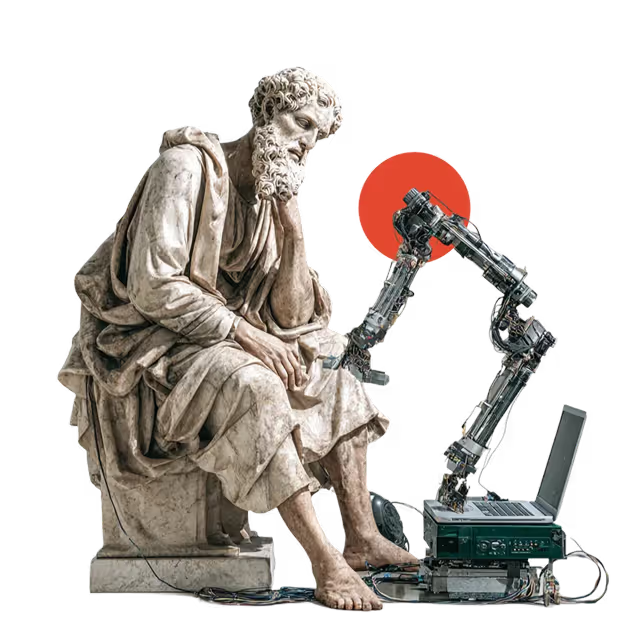
Startups are science in discovery but business in execution. We have industrialized execution for centuries. It’s now time to industrialize discovery. This is what we set out to do at OSS.
The beginning of innovation is the hardest part: everything is unclear, and every decision is make-or-break. Our role is to bring scientific rigor into this early, chaotic stage. For founders, we’re the first co-founder, running alongside them through the idea maze from day zero. For industry partners, we’re the frontline partners – bringing new weapons, sharper tactics, and the grit to see it through.
Deep Partnerships for
Large scale problems
Partnerships with leading industry operators and exceptional founders are at the core of how we industrialise discovery. It’s a win-win-win: industry partners gain unprecedented access to new ways of solving problems inside their factories; founders no longer have to fight the hardest stage of company building alone; and society benefits as more talent moves to where the world needs them most.































Scientific Methology
Data-Driven And Scaleable
Discovery is the search for truth – not only about what product to build but also the right way to sell and scale it. It’s not a phase, but a strategic layer that never fully disappears – it resurges as markets evolve or scaling exposes new unknowns. We validate 6 key fundamentals: problem, user dynamics, causal mechanism, high-leverage solution hypothesis, economic logic and GTM mechanism. Think of them as scientific variables that decide whether a startup has a reality underneath it.
Why Manufacturing
Needs industriaLised Discovery
Stubborn Complexity
Manufacturing discovery requires both software and hardware intelligence. This creates an incredibly complex discovery problem. Industrializing discovery has the highest leverage here.
Opportunity Cost
Manufacturing has the highest cost of wrong discovery: machines stop, safety risks appear, millions in production loss, recalls, supply chain disruptions, and compliance issues.
Structural barriers
Manufacturing lacks the cultural and organizational capacity for innovation: execution-oriented, weak experimentation culture, limited software literacy, risk-averse, low tolerance for failure, and multi-level decision chains.
Outsized impact
When done right, manufacturing offers the highest return on discovery per unit of insight: millions saved, supply chains stabilized, environmental and social footprint reduced.